
Your beautiful baby is a joy to you and your entire family and is perfect in every way. Nine long months of waiting have given you the opportunity to enjoy a lifetime of both happiness and challenges involved in raising a child to adulthood. You did notice that his or her ears look like someone else in the family, perhaps several others, because they stick out from the head farther than what seems normal. This is called protruding ears, as well as prominent ears. Can they be changed? Yes, they can. That’s the basis of this blog post: to help parents understand the causes of prominent ears as well as the options to make prominent ears appear normal.
What Are Prominent or Protruding Ears?
Prominent or protruding ears are one of the most common congenital (born with it) ear deformities, or differences. Present at birth, they are caused by the way the cartilage in the outer ear(s) develop prior to birth.
What Causes Prominent or Protruding Ears?
The shape is determined during fetal development in the womb. There are a few causes, including the following:
1. An Underdeveloped Antihelical Fold
The antihelical fold is the curved ridge just inside the outer rim of the ear. If it doesn’t fully develop, the ear lacks a normal backward fold and sticks out farther from the head.
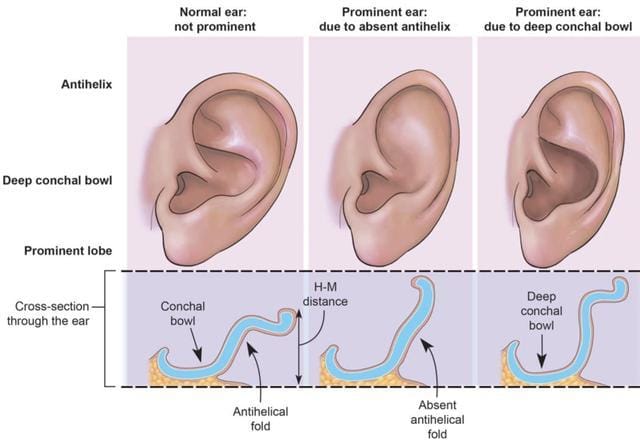
2. Over-developed or Enlarged Conchal Bowl
The conchal bowl is the cup-shaped hollow of the outer ear that leads into the ear canal. If it is especially deep or large, it can push the entire ear away from the side of the head.
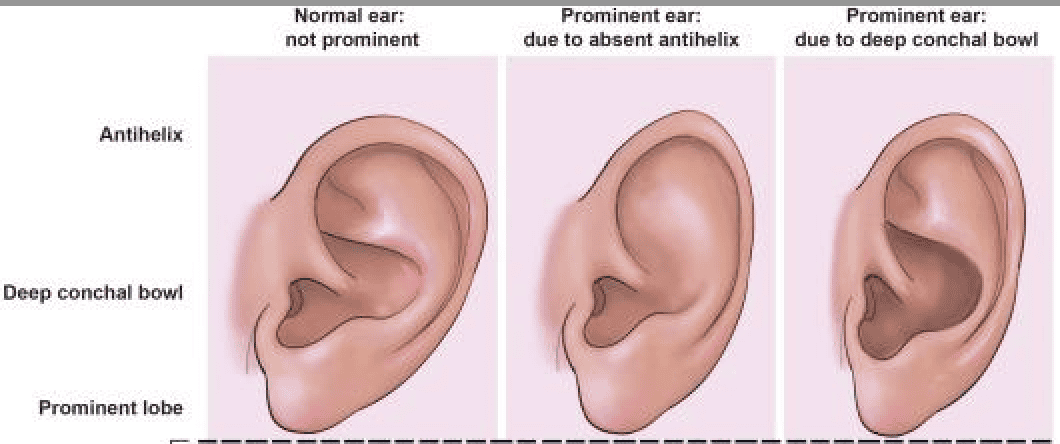
3. Both an Enlarged Conchal Bowl and Underdeveloped Antihelical Fold
It’s common for children with protruding ears to be caused by both, which creates a very pronounced prominence.
4. Genetics
Prominent ears very often run in families. If one or both of the baby’s parents have protruding ears, the baby is more likely to have them.
What Does Not Cause Protruding Ears?
- Sleeping on one side
- Pulling or touching the ears
- Wearing hats
- The baby’s position after birth
Are Protruding Ears Harmful?
Rarely are prominent ears a physical problem that is harmful to your baby. Prominent ears do not affect your baby’s hearing, and don’t interfere in any way with your baby’s brain development. They are primarily just a cosmetic difference; however, that difference has been known to cause teasing and even bullying by peers and sometimes even by family members.
Can Protruding Ears Correct Themselves?
Sometimes.
A mild prominence can improve slightly during the first few weeks or months, as the swelling from birth diminishes and the ears assume a more natural position.
However, true congenital prominent ears caused by the above issues do not correct on their own. The challenge is that neither you nor your pediatrician can know for sure during the first few weeks after birth—the period of time during which a nonsurgical treatment like EarWell must be applied to be effective.
Why Is Early Treatment Essential to Remodel Prominent Ears?
A newborn’s ear cartilage is temporarily soft due to maternal estrogen. For this reason, ear molding must be started within the first 3 weeks of life to reshape the ear without surgery. Once the cartilage stiffens, around the sixth week of life, EarWell may not be effective and your baby will require otoplasty—ear surgery—when he or she reaches kindergarten or first grade, or go through life with protuberant ears. An otoplasty is expensive and almost never covered by health insurance because insurance companies understand the procedure is cosmetic.
Why EarWell is the Logical Solution for Prominent Protruding Ears
A painless resolution to your baby’s prominent ears is uppermost in your mind. You don’t want your little one to experience pain to remodel his or her ears, right?
EarWell is
- absolutely painless,
- resolution is very rapid (approximately six weeks), and
- your health insurance (including Medicaid or military health insurance) will likely pay for it.
How To Know If EarWell Is Right for Your Baby
If your baby has an external ear deformity of any kind, including prominent or protruding ears, it’s essential that he or she be examined by a specially trained EarWell physician who can give you an accurate diagnosis and let you know whether or not EarWell can reshape your baby’s ears. This needs to occur as soon after birth as possible because, as mentioned above, once the ear cartilage begins to harden around week six, even EarWell reshaping may not work, leaving you with no options other than ear surgery later on.
What To Do Now
Go to our Physician Provider Directory and locate the specially trained EarWell provider nearest you. If you have any problems or can’t find one nearby, call us as soon as possible at 630-357-7374 or complete this Contact Us Form.
Like you, we want the best for your baby. Our experience for decades improving the appearance of thousands of newborns tells us that EarWell is the perfect, painless solution for external ear abnormalities. We are here to help. Don’t wait until a painful surgery is your only solution.