
Congratulations on the birth of your newborn! Undoubtedly, your little one is the apple of your eye, and you’re grateful to have a beautiful, healthy baby! However, there’s one thing that you notice that concerns you a bit: your baby’s ears stick out more than normal. You might even find yourself thinking about “dumbo ears” and wondering if this will go away as your baby grows, or whether your little one will have to grow up with ears that noticeably stick out. Will others make fun of him/her? What should you do if your baby truly has dumbo ears?
This blog post is a compassionate guide for parents concerned about their baby’s protruding ears, explaining why they occur and how non-surgical correction works best in the first few weeks of life, without surgery or pain.
What are “Dumbo” Ears?
It’s sad—but not uncommon—that those with protruding ears (the proper term for ears that stick out) are teased and even bullied by others. It’s unquestionable—and unfortunate—that many in our culture view protruding ears as less attractive than ears that sit a more normal distance from the side of the head. While it’s good to know that your baby’s protruding ears are a harmless ear abnormality, you may be unsure whether anything can be done to improve them. Keep reading, as there is!
Protruding Ear deformity is a positional deformity, in which the ear sticks out more than average from the side of the head, i.e., usually more than 2 cm (about ¾”). The inner ridge of the ear is typically underdeveloped, making the deep bowl of the ear enlarged. The shape of the ear is usually normal, just angled outward.
You may be unsure if your baby has what’s called a “Cup Ear” deformity, which also results in an ear that appears to stick out. However, in a cup abnormality, the upper third of the ear is tightly rolled or collapsed, results in an ear that appears “cupped,” hence, the name. In a cup ear deformity, the upper ear bends downward, making the ear appear to stick out and look a bit smaller than normal. It can range from a very mild Type I to a severe Type III. Although a cup ear deformity can affect the shape of the ear canal, it does not usually affect hearing.
A protruding ear can sometimes be part of a Stahl’s Ear deformity. Stahl’s Ear is one in which the ears are quite pointed at the top. It’s often called Spock or Elfin ear. We have numerous blog posts on this website about Stahl’s Ear. Not every protruding ear deformity is a Stahl’s deformity (and vice versa) but they can occur together. Your physician will confirm for you whether your baby has a simple protruding ear deformity or also has a Stahl’s ear deformity. Thankfully, both can be addressed with EarWell treatment.
Examples of a Protruding Ear Deformity:
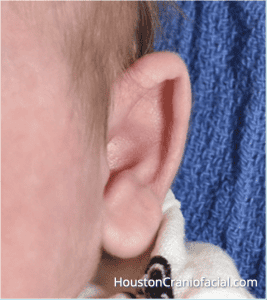
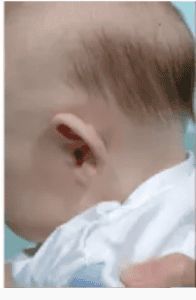
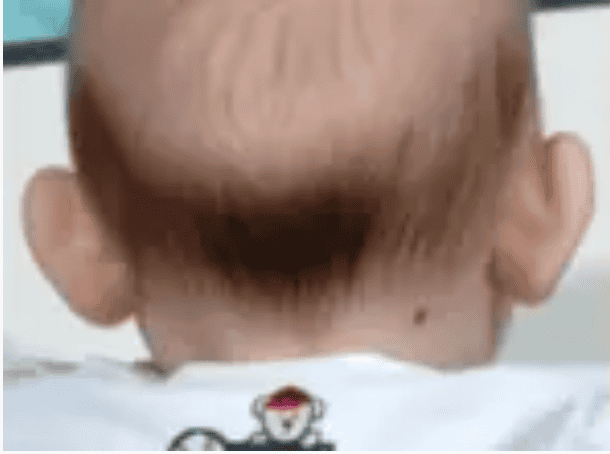
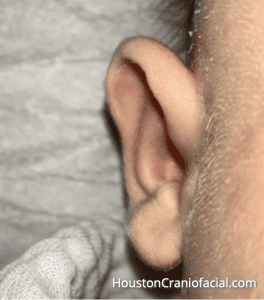
Common Causes for Protruding Ear (Dumbo Ears) in Newborns
- .The curved ridge just inside the outer rim of the ear (called the antihelix) doesn’t form well. This is the most common cause of protruding ears.
- Extra cartilage in the deep bowl of the ear that leads to the ear canal (called the concha). When this cartilage is too large, it pushes the ear away from the side of the head
- A combination of both of the above factors.
- Family tendency: protruding ears often run in families, since cartilage shape is inherited, just like the size and shape of the nose and other physical features.
- Position in the womb: If the baby’s ear(s) are folded or oddly shaped before birth, it might settle into a protruding shape.
- Ear trauma during fetal development—which is extremely rare.
- Cartilage or connective tissue disorders—again, extremely rare.
How Common Are Protruding Ears?
About 20-35% of all newborns have some kind of external ear deformity. Protruding ears are fairly common—about 5% of the population has them. Many parents notice what are often called ‘dumbo ears’ and wonder if they will correct on their own, but early intervention can help ensure the best results.
How are Protruding Ears Treated?
There are several options if your baby has protuberant ears:
- Do nothing.
Unlike some of the other external ear abnormalities, most prominent ear abnormalities do not self-correct.
2. Wait Until the Child is School Age for Ear Surgery
Ear Surgery, called Otoplasty, is an option for ears that stick out.
There are several drawbacks to this choice:
- It cannot be performed until the child is 6-7 years old.
- It’s painful and requires dressings afterwards, which can be challenging with a young school-aged child.
- Kids are active. After surgery, your child must avoid certain activities to protect the ears while healing.
- Insurance doesn’t cover it, as it’s considered to be cosmetic surgery. An Otoplasty typically costs between $4,500 and $8,000, depending on which plastic surgeon you choose.
- Anesthesia is always a risk, particularly for a young child.
- Infection is a risk of any surgery.
Remolding with EarWell
Proven over decades, EarWell application has successfully remolded 98% of infant ear deformities, including protuberant ears and dumbo ears. The process is completely painless and is nearly always covered by health insurance, making it a safe and accessible option for concerned parents.
Why EarWell is the Best Choice for Dumbo Ears or Prominent Ears
EarWell is proven, fast, painless and quite possibly covered by your health insurance, even public and military insurance. Ignoring the problem or waiting to have ear surgery when your baby reaches school age means exposing your child to the potential for teasing and even bullying by other children or even family members, who notice your child’s prominent ears. Why subject your child to the potential for this when EarWell has been proven to correct prominent ears in such a short period of time and without any discomfort to your baby?
How EarWell Works
At your first appointment with your local EarWell Physician, who is specially trained to apply EarWell, he or she will confirm the type of external ear deformity your baby has, and tell you how likely it is that it can be remedied with EarWell. If you and the physician both agree to move forward, EarWell can likely be applied at that first visit.
Your baby will never notice EarWell. It isn’t painful at all—during application some babies will fuss, not because it’s painful to them, but because the provider is fiddling with their ear(s) and holding their head in place for several minutes during application. There are no incisions or anesthesia, and no recovery time required.
About two weeks after the first application, you’ll return to your EarWell Physician’s office to replace EarWell, because the device loosens as your baby’s hair grows, skin sloughs off, and shampoo loosens the special adhesive that keeps EarWell attached. There is no discomfort to your baby to switch out one EarWell device for a new one.
Depending on the severity of your baby’s external ear deformity, you may return once or twice more for a removal and replacement of EarWell, or until your EarWell provider finds that your infant’s ears now have a normal appearance, which happens in about 98% of all EarWell applications. As an aside, most babies wear three sets of EarWell over the course of 6-8 weeks, so if that’s the time frame your EarWell Physician gives you, it’s completely within the usual range for full treatment.
The Bottom Line
If you’re concerned about the shape of your newborn’s ears, it’s important that you follow this link to find an EarWell physician nearest you. If you have any questions or trouble finding an EarWell Physician close by, call us. You have a short window of opportunity (3-5 weeks after birth) while the baby’s ear cartilage is still very soft and flexible, to get the best results from EarWell, so it’s best to get going on this as soon as you can. Read more: Information for Parents.