
Lidding Ear Deformity: How To Correct the Upper Ear Fold in Babies
Even an otherwise perfect-looking baby can have a slight external ear abnormality. One
of them, among many, is the harmless Lidding Ear Deformity. Your baby might have a
lidding ear deformity if one or both of his/her ears look similar to the photos below:
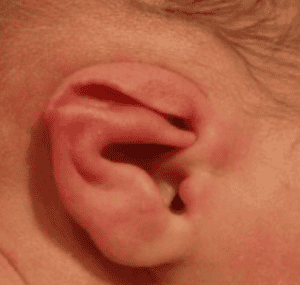
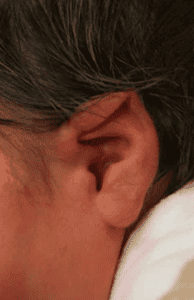
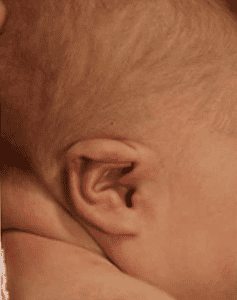
What Is a Lidding Ear Deformity?
A lidding ear deformity is a congenital (i.e., the baby is born with it) ear irregularity in
which the upper portion of the ear, particularly the outer rim (called the helix), is folded
or “lidded” over itself. This gives the ear a hooded or closed appearance, resembling a
“lid” over the ear’s upper edge. Unlike some ear malformations, a lidding ear is
generally considered an ear deformity rather than an ear malformation, meaning the ear
structures are present but misshapen.
Does a Lidding Ear Deformity Affect My Baby’s Hearing?
A Lidding Ear Deformity affects the ear’s shape but usually does not impact hearing.
What Causes a Lidding Ear Deformity?
A lidding ear deformity is caused by abnormal shaping of the ear cartilage in the womb.
Causes may include:
- Womb Position: Pressure on the baby’s ear during pregnancy can cause the
soft cartilage to fold over. - Differences in Cartilage Development: The cartilage fails to develop adequate
stiffness for support of the upper ear. - Pressure on the Ear After Birth: Although this is less common, pressure on the
ear in the immediate newborn stage can contribute to or worsen an existing fold. - Combination of factors: Many cases occur without a clear single cause, but it is
generally not a genetic malformation.
Can a Lidding Ear Deformity Be Fixed?
Yes, a lidding ear deformity can be remolded into a normal appearance via ear molding
with EarWell. Ear surgery is an option if the child is too old for an EarWell application.
The most effective treatment for a Lidding Ear Deformity is ear molding with EarWell, a
soft, painless device that reshapes the baby’s cartilage over a period of just a few
weeks. There is no surgery, pain, recovery, or extended treatment required.
EarWell Works Best When Started Within the First Three Weeks of Life
Time is of the essence to remold any ear abnormality, including a Lidding Ear Deformity.
When a baby is born, there is a high level of estrogen in the baby’s system. This fades
over time, generally dissipating by the time the baby is about six weeks old. While the
estrogen is still high, the cartilage in the ears remains pliable and, therefore, easy to
reshape.
Furthermore, EarWell is completely painless to the infant, requires no injections, no
surgery, and no numbing of the ears. Your baby will not even notice EarWell. A one-
hour visit with a specially trained EarWell physician is all it takes to confirm the type of
external ear deformity your baby has and for your first application. In general, three
visits bring resolution, usually spaced about two weeks apart, since shampooing and
growth of the baby’s hair under the EarWell make it necessary to replace it.
What Does It Cost to Treat My Baby’s Lidding Ear Deformity?
You will be relieved to know that EarWell has been well supported by health insurance
companies, including military insurance and public insurance (Medicaid, etc), and is
usually completely covered, unlike a surgical treatment. If you miss the short window
(the first few weeks after birth) for an EarWell application, an ear surgery, called
otoplasty, is an alternative. However, an otoplasty cannot be performed until a child is at
least 5 or 6 years of age, and insurance almost never covers it, as it’s deemed a
“cosmetic” procedure.
Can Ear Molding Fix a Lidding Ear Deformity in an Older Child or Adult?
Unfortunately, once the ear cartilage is mature (the estrogen stores are depleted),
molding is no longer a solution. That’s why it’s so essential to contact an EarWell
physician as soon as possible after your baby is born.
How Successful is EarWell for a Lidding Ear Deformity?
For a true lidding deformity treated early with ear molding, success rates are generally
high, and many infants achieve a normal or near-normal ear shape without surgery.
How Long Does It Take to Reshape a Lidding Ear Deformity?
As mentioned above, it usually takes about six weeks to remodel most infant external
ear deformities such as a Lidding Ear Deformity.
What Should You Do if Your Infant Has a Lidding Ear Deformity?
If your baby is less than 3 to 6 weeks old, it’s worth having the ear(s) evaluated by an
EarWell specialist, who has been extensively trained in the diagnosis of external ear
deformities such as Lidding Ear Deformity, and who can advise you as to the likelihood
that EarWell can help your baby.