
Congratulations on the birth of your newborn baby! You might have noticed—or a friend or family member noticed—that your baby has pointy ears at the top, more than you might expect. The first thing you probably did was to confirm that your infant has 10 fingers and 10 toes and that he or she seemed normal and healthy. You might wonder if this will go away as the baby grows, or whether this indicates a hearing or other problem. Should you treat this or hope the baby grows out of it? This blog post explores the causes of pointy ear deformations in infants, how common they are, and how early invention with EarWell can reshape the ear without surgery or pain, especially for parents concerned about pointy ears in newborns.
What are “Pointy” Ears?
Pointy ears in newborns are often described as “elfin,” “Spock,” or “Vulcan” ears. They are almost always a harmless congenital ear deformity known as Stahl’s ear and are almost never connected to a hearing loss or other health problem.
What Is Stahl’s Ear Deformity?
Stahl’s Ear is diagnosed when the baby has an extra fold of cartilage in the upper part of the ear, causing the ear’s rim to flatten or point upward instead of curving smoothly. Stahl’s Ear can occur in just one ear or both ears. This extra fold is what gives some babies the appearance of pointy ears, which can be noticeable right after birth. Although the shape may look unusual, the condition is harmless and does not affect hearing or development.
Examples of Stahl’s Ear Deformity:
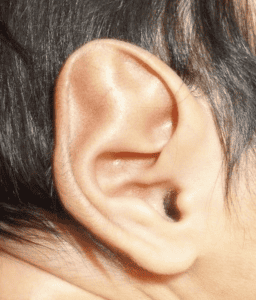
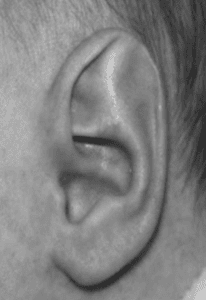
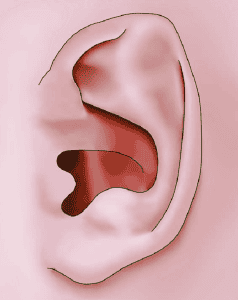
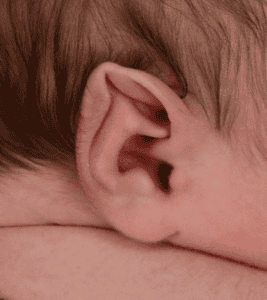
Common Causes for Stahl’s Ear (Pointy Ears) in Newborns
Occurrence during the mother’s pregnancy
The baby’s ear develops an extra horizontal fold or abnormal muscle insertion, causing the pointy appearance
The baby’s womb position caused pressure on the ears while they were developing, creating a pointed ear.
Genetics
The shape of ears is strongly genetic. Pointed ears often run in families and are not associated with any specific health issue.
Pointy ears can be associated with certain syndromes, but this is quite uncommon, and there would be other signs that your doctor would recognize. Examples include DiGeorge Syndrome, Trisomy, and Beckwish-Wiedemann syndrome but, again, none of these would present with pointy ears as the only sign of a disorder.
How Common Is Stahl’s Ear Deformity?
About 20–35% of all newborns have an external ear deformity, such as protuberant ears or lidding (where the top of the ear bends forward), as just two examples. Approximately 8% of all newborns have a Stahl’s Ear deformity. While this may sound like a high number, most of these ear shape differences are mild and often go unnoticed unless a parent or healthcare provider looks closely. Many parents are surprised to learn how common these conditions are, and understanding the statistics can be reassuring—especially when realizing that most ear deformities are harmless and highly treatable during the newborn stage.
How Is Stahl’s Ear Treated?
There are several options if your baby has pointy ears that have been diagnosed as Stahl’s Ear.
Do nothing.
Sometimes external ear deformities, especially mild ones, will resolve on their own.
Wait Until the Child is School Aged for Ear Surgery
Ear Surgery, called Otoplasty, is an option for an external ear deformity.
There are several drawbacks to this choice:
Ear reshaping surgery isn’t covered by health insurance, as it’s considered a cosmetic surgery. An Otoplasty costs somewhere between $4500 and $8,000, depending upon the plastic surgeon that you choose.
Surgery is always uncomfortable, particularly for a young child.
Recovery takes a few weeks, during which you need to keep the ears covered and make sure your child avoids anything that might damage the post-surgery ears (sports, rough housing with friends or siblings, etc).
Surgery is always a risk, regardless of how minor. Anesthesia can affect anyone negatively, and infection is always possible.
Consult an EarWell Physician
Within just a few weeks, EarWell application will remold 98% of infant ear deformities, including pointy ears. The process is gentle, completely non-invasive, and designed to fit comfortably on a newborn’s ear without causing any pain. Most parents are surprised at how quickly they can see visible improvement, often within the first couple of weeks. Because the treatment is almost always covered by health insurance, families can correct pointy ears early without worrying about high out-of-pocket costs. Early intervention not only helps achieve a natural ear shape but can also prevent potential self-consciousness or teasing as the child grows.
Why EarWell is the Logical Choice for Stahl’s Ear Deformity
Immediate resolution to an external ear deformity eliminates the potential for teasing and bullying as the child is exposed to other children or even family members, who notice your child’s unusual appearance. Why subject your little one to even the potential for this when EarWell is easy, fast, painless and quite possibly without an out-of-pocket expense?
At your first appointment with your local EarWell Physician, who is specially trained to apply EarWell, he or she will confirm the type of external ear deformity your baby has, and tell you how likely it is that it can be remedied with EarWell. If you and the physician both agree to move forward, EarWell can likely be applied at that first visit.
Your baby will never notice EarWell. It isn’t painful at all—during application some babies fuss, not because it’s painful, but because someone is fiddling with their ear(s) and holding their head in place for several minutes during application. There are no incisions or anesthesia, and no recovery time required.
About two weeks after the initial application, you’ll go back to your EarWell Physician to remove and replace EarWell, as your baby’s hair will grow, skin will slough off, and shampooing has the potential to loosen the special adhesive that keeps EarWell attached.
Depending on the severity of your baby’s external ear deformity, you may return once or twice more for a removal and replacement of EarWell, or until your EarWell provider finds that your infant’s ears have completely remolded into a normal appearance, which happens in about 98% of all EarWell applications. As an aside, most babies wear several sets of EarWell over the course of 6-8 weeks, so if that’s the time frame your EarWell Physician gives you, it’s completely within our usual range for full treatment.
The Bottom Line
If you’re concerned about the shape of your newborn’s ears, it’s important that you follow this link to find an EarWell physician nearest you. If you have any questions or trouble finding an EarWell Physician close by, call us. You have a short window of opportunity (3-5 weeks after birth) while the baby’s ear cartilage is still very soft and flexible, to get the best results from EarWell, so it’s best to get going on this as soon as you can.