
Understanding Newborn Folded Ear Deformities
Now that your newborn has arrived and you’ve confirmed that everything is as it should be, and the friends and family members have joined you in holding and cooing at your perfect baby, you might have noticed something out of the ordinary about your baby’s ears: they appear to be folded over where they should be rounded in a normal curve. Your newborn may have what is called a folded ear congenital ear deformity.
What is a Folded Ear Deformity?
When the ear cartilage is bent, folded over, or creased where normal curves and ridges should be, this is a folded ear deformity. Part of the ear might be bent backwards, forward or inward, even though the ear is fully formed (no parts missing). Some babies’ ears have a very slight bend, which is considered a mild deformity, and some have ears that appear flattened or even crumpled like folded paper.
There Are Four Types of Folded Ear Deformities
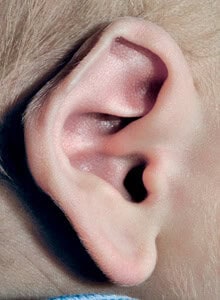
Helical Rim Folding
The outer edge is bent.
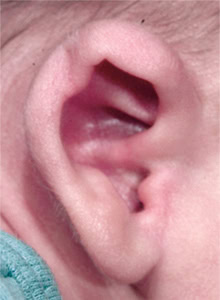
Constricted Ear
The upper ear is tightly rolled, with a fold.
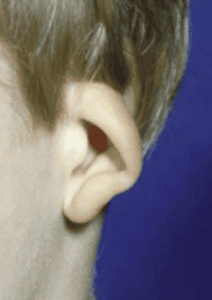
Cup Ear
The ear appears particularly small and/or folded inward.
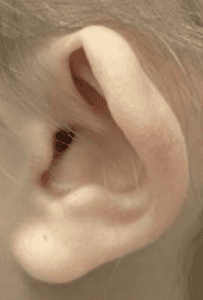
Lop Ear
The top of the ear folds downward, like the ears of newborn puppies before they “stand up.”
What Caused My Baby’s Folded Ears?
Here are four reasons that may have caused your baby’s Folded Ear Deformity:
- The ears were bent from pressure in the womb
- The ears were bent during delivery
- Folded ears may be genetic: are there others in your family with folded ears?
- The level of a mom’s estrogen circulating in the baby can leave the baby with very soft ear cartilage.
Will My Baby’s Folded Ears Fix Themselves?
About 30% of all newborn external ear abnormalities with resolve on their own, especially mild folds. This will happen within the first few weeks of life as the mother’s estrogen levels in the baby lessen, which usually takes about six weeks. As the cartilage hardens, the ears change.
The obvious challenge is this: without a crystal ball, you have no idea whether your baby’s ears will become normal over the passage of time or not. There’s a tiny window of time during which treatment can give your baby perfect ears: treatment must begin within the first 3-4 weeks after birth. Miss that short window and nothing will fix your baby’s ears other than surgery (called otoplasty), which cannot be performed until the child is school-aged, i.e., 5 or 6 years old.
How to Treat Folded Ears in Newborns
- Do nothing and hope it becomes normal on its own:
As mentioned above, about 30% of infant external ear deformities will reshape on their own. Again, the problem is not knowing whether this will happen for your baby. If you wait too long and the ears do not improve, it will be too late for early ear molding and years too early for a surgical resolution.
- Apply early ear molding
EarWell is the decades-long gold standard for treating misshapen infant ears within weeks, without pain, without surgery and, in most cases, paid for by health insurance, including public and military insurance coverage. This ear molding technology is fast and effective, with over 95% of all babies’ ears completely normal looking after a brief treatment period.
- Correct later with surgery
Otoplasty, the name of the surgery that treats all kinds of external ear abnormalities, is performed by a plastic surgeon. It cannot be done until the child is about 6 years of age. It’s a proven method to remodel external ear deformities. The challenges, however, are numerous:
- Your child goes through at least the first 6 years of life with ears that appear abnormal to others. This can lead to teasing, even bullying which, even after repair has been done, may continue to affect a young child’s self-esteem. Your child’s ears may seem minor to you but, to a young one, it can take on a larger focus in his or her life than you would anticipate.
- Surgery is an invasive procedure, even for ear surgery. Anesthesia is used, which rare, can cause challenges in and of itself. There is always a risk of infection with any surgical procedure, even a small one. The child must tolerate discomfort, dressings, and physical restrictions to be sure he or she doesn’t damage the ears during healing through sports or roughhousing with friends or siblings.
- Cost is a factor. Insurance almost never covers ear surgery unless it’s a case of microtia (parts or all of the ear is missing). Otoplasty procedures are considered by health insurers to be cosmetic, not essential. Depending on where you live and the surgeon you choose, fees could easily exceed $6,000 for the surgeon, operating room, anesthesiologist and follow up care.
Why EarWell Is the Best Choice if Your Baby Has Folded Ears
There are several reasons why thousands of parents across the globe have chosen EarWell for their babies’ external ear deformities. Here are some of them, and you can view videos on our website posted by parents whose babies were treated with EarWell.
- Ease of Treatment
- EarWell is applied by a specially trained physician at an office visit that takes about an hour.
- Parents return with their baby about every two weeks so the physician can reapply the EarWell, which loosens as the baby sheds skin, has their hair washed, etc.
- The total treatment period is usually about six weeks, depending on the extent of external ear deformity and the age of the baby when treatment starts: the sooner you bring in your baby, the shorter the treatment period will likely be—although each child is unique. The goal is to remold the ears within 6-8 weeks.
- The Baby’s Comfort
There is no discomfort for your baby. It’s normal for your baby to fuss during application because he or she is being restrained while the provider applies EarWell, but application goes quickly. Babies have no discomfort during the 6-8 weeks that they are wearing EarWell.
- EarWell is a Permanent Solution
Correction of external ear deformities such as folded ears is permanent after EarWell treatment. There is rarely a need to seek out surgery later if application is done within the first 1-3 weeks after birth. Furthermore, if your provider believes your baby’s external ear deformity will either not correct with EarWell or will not correct fully, he or she will tell you this at your first appointment.
- Insurance Covers
We have been providing EarWell external ear deformity correction for decades. In our experience, most health insurance plans fully cover the cost for EarWell correction. This includes military insurance and public insurance (Medicaid, etc). Your EarWell provider can check with your insurance company to confirm the status of your coverage for EarWell for your baby.
The Bottom Line:
Your baby’s ears concern you. EarWell is a decades-long solution with a nearly 100% success rate. Your health coverage likely pays for it. Treatment is rapid and painless for your baby.
What To Do Now:
Click on this link to go to our EarWell Provider Page. Fill in your country, state and zip code to find the provider nearest you. If you have any trouble, call us at 630-357-7374 during normal business hours, central time. You can also choose to complete this online EarWell contact form.